Tag Archives: Planting

Full-Season Soybean Seeding Rates

My soybean seeding rate recommendation for full-season production systems is to plant enough seed to insure 80,000 uniformly spaced plants/acre.  If you cannot uniformly space the plants within a row, then my recommendation rises to 100,000 plants/acre.  Based on numerous seeding rate experiments conducted in Virginia, I feel very confident in this recommendation.

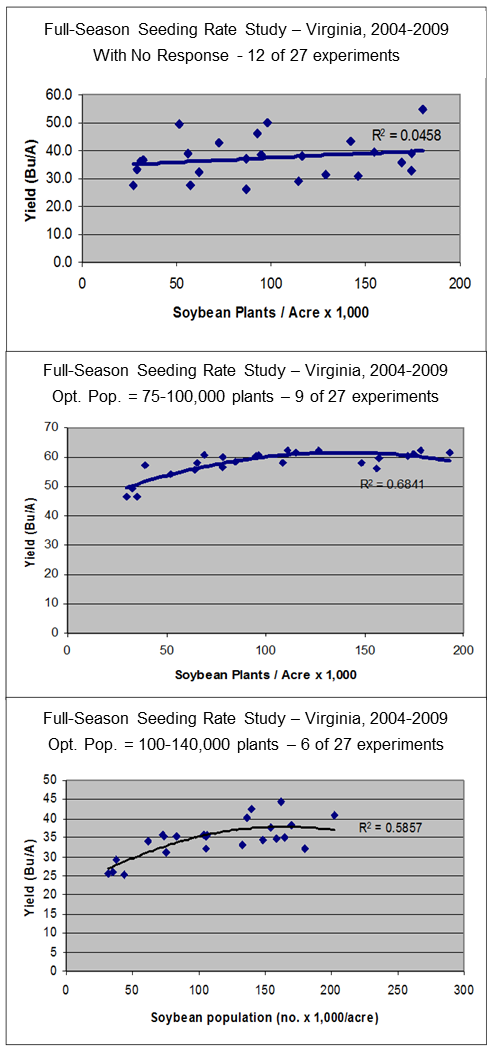
Of the 27 full-season seeding rate experiments conducted from 2004 to 2009, I can group soybean yield response to plant population into the following three categories: 1) no response to plant population; 2) optimum plant population of 75-100,000 plants/acre; and 3) optimum plant population of 100-140,000 plants/acre.  Below are individual tests that represent these categories.

Full-Season Seeding Rate Study - Virginia

First, note that these examples only show the response of yield to plant population and do not take into account seed costs.  When seed costs are included, the optimum plant population is lower than is shown on the graphs.  Also note that these graphs show yield response to plant population, not seeding rate.  To convert to seeding rate, adjust these numbers to reflect your expected percent emergence.  For example if you assume 75% emergence, you would need to adjust your seeding rate to 133,000 seed/acre to obtain 100,000 plants/acre.

We conducted these experiments with maturity group 4 and 5 varieties.  While one may think that more seed might be required for early-maturing varieties, this was not the case (i.e., group 4 and 5 varieties responded similarly).

There may be some correlation with yield potential as listed below:

  • 30-40 Bu/A Yield Potential (14 tests)
    • 6 required 100-130,000 plants/acre
    • 2 required 70-100,000 plants/acre
    • 6 had no yield response
  • 40-60 Bu/A Yield Potential (7 tests)
    • 2 required 70-100,000 plants/acre
    • 5 had no yield response
  • > 60 Bu/A Yield Potential (7 tests)
    • 2 required ~130,000 plants/acre
    • 4 required 70-100,000 plants/acre
    • 1 had no yield response

So, what do these data mean?  It means that every environment (year & location) is a little different and there is no way that we can predict with 100% accuracy the exact seeding rate that will be required for your field in the coming growing season.  However, we do know that if we can obtain full canopy closure (90-95% light interception) by full flower (R2 stage) to early pod (R3 stage), we can maximize soybean yield potential.  In a dry year or under a droughty soil (low yield potentials), greater seeding rates will help insure this.  Still in most cases (30 to 60 bushel yield potentials), 70-100,000 plants/acre are adequate.

What about fields with greater than 60 bushel yield potential?  In this case, we need to look beyond adequate leaf area and need to start thinking about how many pods the soybean plant can support.  For instance, at 40 bushels/acre and 100,000 plants/acre, we only need to produce 72 seed/plant (using 3000 seed/lb) or about 30 pods/plant (using 2.5 seed/pod).  But, at 60 bushels/acre, we need to produce 108 seed or 45 pods per plant; at 80 bushels/acre, we need 144 seed or 60 pods per plant.  Considering that 12 reproductive nodes per plant are possible, 4 to 5 pods per node on a rather tall plant would be required.  Although branching will also contribute to yield, that seems a lot to ask of one soybean plant.  So, if you are trying to win the yield contest or are irrigating soybean, I suggest planting enough seed to obtain 120-140,000 plants per acre in a full-season system; otherwise 80-100,000 plants are adequate.

Share

Cool Soils Should Alter Your Planting Plans

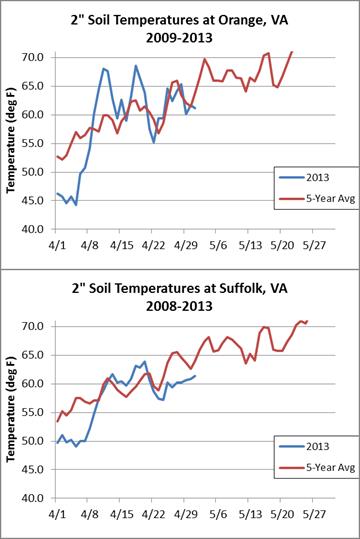
It goes without saying that every year is different and this winter/spring has been wet and cold. I think that most of us have assumed that the soil temperatures are much below normal; therefore, holding off a few days with planting may be a good idea.  According to 2013 and five-year historical soil temperature records at Orange and Suffolk (from the USDA-NRCS Soil Climate Analysis Network weather stations), soil temperatures have been fluctuating quite a bit.Virginia Soil Temps 2013

After early-April soil temperatures proved to be much colder than normal, a week or two of warm weather put us back on track with average.  Then, temperatures dropped off again.  Fortunately, the last two weeks of cool weather have not lowered the soil temperatures all that much.

Although our soils have warmed substantially since early April, the temperatures are still less than optimum for soybean germination and emergence.  Ideally, I like to see temperatures hold steady at 65 to 70O or above.  The ideal temperature for soybean germination is 77O and the optimum range is 68 to 86O.  The maximum is 94O, where germination can be inhibited.  However, we can’t always wait for perfect temperatures if we are to get all of our soybeans planted on time.

Still, planting soybean in cool (<65O) will lead to delayed emergence and increased chance of seedling disease that can reduce stands, weaken emerged plants, and inhibit early-season growth.  For a more detailed description of fungal seedling disease in soybean, refer to an article I wrote last May on the subject and can be found in my Virginia Soybean Update blog.

I stress that the greater time required for emergence, the greater probability that the seed will become infected with soil-borne disease.  If you are planting into cool soils, I strongly suggest using fungicide-treated seed as an insurance against seedling disease. These treatments will protect the seed and seedling if emergence is delayed.

But, seed treatments should not be a substitute for other practices that encourage rapid seedling emergence.  Here is my checklist for insuring a good stand free of seedling disease:

  • Know the germination and vigor of your seed; adjust the seeding rate accordingly.
  • Insure good soil-to-seed contact by properly setting your planter to cut through the residue and penetrate to the proper depth.
  • Plant soybean seed ¾ to 1 inch deep into good soil moisture.
  • Consider fungicide seed treatments if planting into cool soils.
Share

Three Principles of No-Till Planting

Nearly all of Virginia’s soybean acres are planted no-till.  Therefore, most of you are experts at getting a good stand even in heavy residue.  Still, a quick review of the principles of no-till planting is always helpful.  This can be boiled down to three simple steps: 1) Cut the residue; 2) Penetrate the soil to the proper depth; and 3) Insure good soil-to-seed contact.  Some may add a fourth step – close the seed-V, but I consider that part of step 3.  For more information, see VCE publication 442-457, Planter Drill Considerations for Conservation Tillage Systems, which can be found at the VCE web site, http://pubs.ext.vt.edu/442/442-457/442-457.html.

1. Cut the Residue.  In order to cut the residue, it first needs to be spread uniformly over the field.  This begins with harvest of the previous crop.  Residue cannot be cut adequately when residue levels are piled in one place.  Furthermore, disk openers don’t really cut through piles of chaff; instead, it is tilled into the soil, which hinders the third step of insuring good soil (not chaff)-to-seed contact.  Chaff in the seed zone will only pull moisture away from the seed.

Standing residue is easier to plant through than mowed/shredded residue.  So, don’t shred stalks and consider stripper headers for small grains.

Allow the residue to dry and become crisp before planting.  Planting too early in the morning is one of the biggest mistakes made.  Regardless if the planter is set right or not, cutting wet or tough residue is a challenge that might not be overcome.  Remember, 75% of soybean yield is established when you put the seed into the ground.  Don’t get in a big hurry.  Allow the residue to dry.

This should go without saying and I rarely see this being done in Virginia.  But, never burn the straw!  This is a valuable resource.  Burning will remove any nitrogen and carbon and send it up into the air.  This adds to pollution and throws away probably the two most important resources for producing a good crop and improving soil quality.

Once the residue is spread evenly, we can then turn our attention to the planter or drill.  First, adjust the disk openers.  Coulters and disk openers should be sharp, have a diameter large enough to create a “scissoring” action between the blade and ground, and not be bent or damaged.

Double-disk openers should be set to work together with little to no gaps between disks.  Maintain approximately 1 to 1½ inch of contact between the two disks.  If this blade-to-blade contact cannot be maintained, if blade diameter is worn below the manufacturer’s recommendations, or if the blade edge is bent, chipped, or jagged, the blade should be replaced.  Watch the leading edge of offset double-disk openers for significant wear and bending.  Essentially, the leading edge of the disk takes the abrasion and wear of cutting straw or stalks and penetration the soil.  Gradual wear leads to a bigger gap between the double-disks.  If the gap becomes too big or the leading disk edge becomes bent, the disks will push residue into the furrow instead of cutting through it.  For offset double-disk openers, a business card-width gap should be maintained to insure proper operation and prevent the trailing disk from cutting into the leading disk blade.

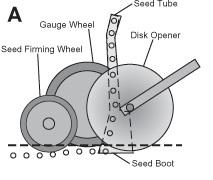
Once insuring that the disk openers can do the job, the next thing to bring your attention to is adequate down pressure.  This is not the same thing as weight.  We can add weight later.  Down pressure is controlled by the springs or hydraulics on the planter.  It’s the amount of downward pressure being applied by each planting unit.  Although adequate down pressure is most related to step 2 – disk openers must penetrate to the proper depth to adequately cut the residue – practices and adjustments within each step may overlap.  The coulters and/or disk openers must act like a pair of scissors.  The drawing to the right illustrates this concept.  The dashed line represents the soil surface and the solid line represents the angle between the coulter and soil.  Note that the coulter is running at the proper depth and the contact angle is about 45O.  At this angle, the cutting is scissor-like and residue will be cut.  Keep in mind that the size of the coulter will affect this angle; bigger is usually better.

Although not necessary, coulters can be added in front of the planter openers to ensure residue cutting.  Like disk openers, the cutting angle must be correct.  All the same principles mentioned thus far and in step 2 apply.  Because coulters are usually mounted several feet in front of the seed opening/placement device (in the case of coulter caddies even further), many use wide-fluted coulters.  A pivoting hitch or a steering mechanism will keep the seed openers tracking in the coulter slots.

2. Penetrate the Soil to the Proper Depth.  The primary differences between conventional planter/drill systems and those designed for conservation tillage systems are down-pressure and weight.  Since openers and soil engaging devices must deliver more down pressure to penetrate firmer no-till soils and cut the residue, conservation planter/drill systems include heavy-duty down-pressure devices, are built heavier, and have the ability to carry much more weight than conventional tillage systems.  Penetrating the soil to the proper depth may require up to 500 pounds of down-pressure per planting unit.  Down-pressure springs are adjustable and multiple springs can be added if insufficient pressure is achieved.  Hydraulic down-pressure controls are also available.  Only after adequate down-pressure is achieved are we ready to add weight to the planter/drill.  Adding weight by itself will not ensure penetration to the proper seeding depth.  Add sufficient weight to the planter to ensure penetration of the coulters and seed furrow openers into untilled soil, and to keep the seed-metering drive wheels on the ground.

Soil type affects planting depth.  The planter/drill will tend to sink and begin dragging up residue if it moves out of heavier soil into a lighter soil, if the planter moves from a no-till to a tilled area, or if the planter moves from compacted land to that which is not compacted.  The result is that the coulters move too deep and begin pushing, instead of cutting, the residue.  Never set the planter on the field edges where the soil is more likely to be compacted or in an unrepresentative soil.  Wide gauge wheels, drill units that do not run side-by-side but are offset, and high clearance will reduce residue dragging when in a field with highly-variable soil types
.

3. Insure Good Soil-to-Seed Contact.  Good soil-to-seed contact cannot be achieved unless the first two steps are performed correctly.  If the first two steps were carried out correctly, the last step will be much easier.  There are two methods for seed-depth control on most no-till planter/drill systems: 1) setting the depth from a gauge wheel adjacent to the seed furrow device or 2) adjusting press wheel pressure behind the seed furrow openers.  The disadvantage of any system using the press wheel for depth control is its distance from the seed opener.  As the distance increases there is a greater possibility that irregular terrain will influence both depth control and the press wheel’s ability to provide good soil-to- seed contact.  Depth control from an adjacent gage wheel is preferred.  In either case, keep adequate pressure on the gauge or press wheel to force the openers into the soil to the proper depth.  For more detailed discussion on the advantages of different types of press wheels (i.e., flat, ribbed, angled, etc.), see VCE publication 442-457 referenced earlier.

Sufficient weight must remain on the press wheels to ensure firming of the seed into the soil.  Wet soil is easily compacted and care must be taken not to over pack the soil, making it difficult for seedling roots to penetrate the soil.  In dry soil conditions, extra closing force may be needed.  The key is to evaluate seed-to-soil contact, not just closing the top of the seed-V.  As long as the contact is maintained, something as simple as a harrow that acts to close the top of the V and pull light residue cover back over the V may be all that is needed.  This is a common practice on drills that use a narrow press wheel.

These three principles will make you successful at no-tilling soybeans, or any crop for that matter.

Share

Lower Seeding Rates & Maintain Yields with Narrow Rows & Uniform Stands

Before the cost of soybean seed jumped with the introduction of the Roundup-Ready trait, soybean was planted at much greater rates than was needed for maximum yields. Back then, seed was cheap. It only cost a few dollars to insure adequate stands – even if only 50% of those seed emerged. Today, planting extra seed is a luxury that we can no longer afford, especially if the seed includes one or more of the many seed treatments now available. Furthermore, with better planters and drills that easily handle residue and place the seed at the proper depth, we tend to get better stands. But, just how low can we go? How many seed per acre does it take to maximize yield?
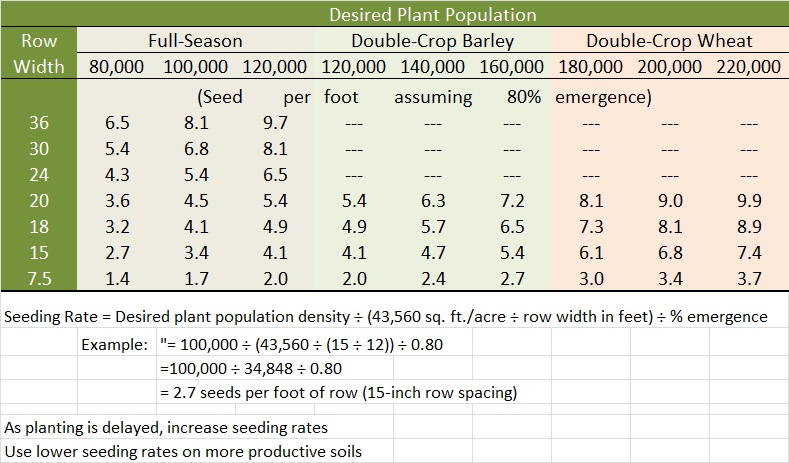
Over the past 8-10 years, I’ve collected a lot of seeding rate data on different soils throughout Virginia. The main conclusion from that research was that seeding rate recommendations were too high for full-season (May-planted) soybean and barely adequate for double-cropped (late June- to July-planted) soybean. Over the past three years, I’ve also collected quite a bit of data following a barley crop (early June planted) and I feel comfortable with relatively low seeding rates for this cropping system. My current recommendations are listed below. Note that the table lists the desired final plant population in plants per acre and the seeding rate calculations (in plants per row foot) are based on 80% emergence. Your final stand may vary depending on emergence. In general, for May plantings, 80,000 plants per acre are adequate for all row widths.

Suggested Soybean Seeding Rates for Virginia

Don’t Widen Rows to Save Seed. I’ve heard talk of widening rows to save seed. It’s true that if you move back to 30 or 36” row spacing, you’ll not use as much seed. That’s because you can only crowd so many plants into a row and get a benefit. Basically, too many plants within the row are competing with each other. But, you’re losing the benefit of narrow rows, which is, once again to capture 90% or more of the sunlight by flowering and early pod development. Sure, it’s possible that in a good year on a good soil, you’ll be able to meet these requirements. But over time, it’s not likely. On the other hand, row spacing of 15 to 20 inches should provide adequate canopy if planted in May through mid-June. Keep in mind that the later you plant, the greater the benefit from narrow rows. Also, narrow rows benefit early-maturing varieties more than late maturing varieties. And, as I’ve alluded to earlier, there is less of an advantage to narrow rows on more productive soils. Therefore, some fields will likely respond more to narrow rows than others.

Here’s a good way to check and see if your row spacing is narrow enough for a particular field. This summer, when the soybean crop is in full bloom, walk your fields. As you’re walking, look into the canopy. Can you see any ground? If so, then you’re rows are not narrow enough. If you’re already planting in narrow rows, then consider raising your seeding rate. This will insure that you’re meeting the leaf area requirements.

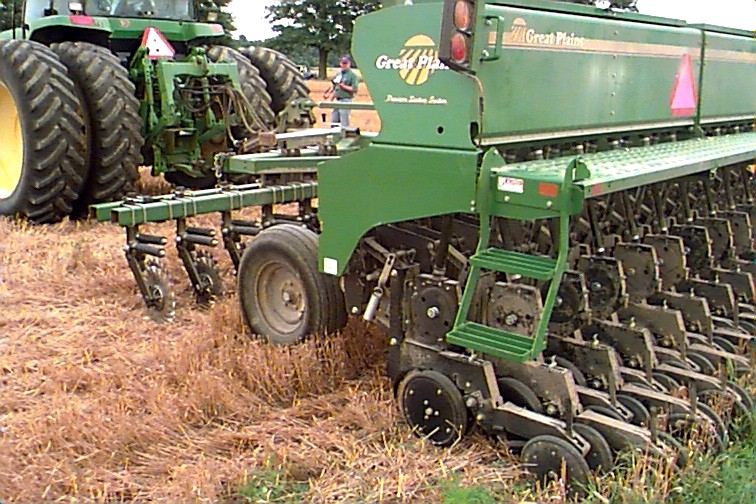
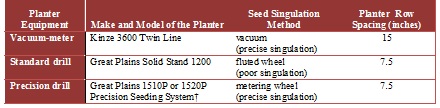
Uniform Stands Matter. We generally think that soybeans will compensate for poor stands, wide rows, and/or gaps within rows. Soybean will compensate much more than other crops. However, I think that uniformity of stand within the row matters.  The more uniform the spacing between plants within a row, the greater the yield potential. This was shown with double-cropped soybean in research conducted in Virginia that compared a 15-inch planter with a standard drill and a drill that uniformly distributes the seed in the row (see figure below). I’ll refer to this drill as a “precision drill.” Details of the drills used are shown below.

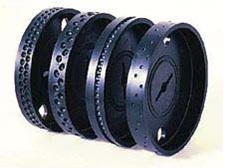
Meteriing wheels for various seed types in the Great Plains 1510P or 1520P Precision Seeding System

Type, make and model, seed singulation method, and row spacing of seeding equipment used in this study.

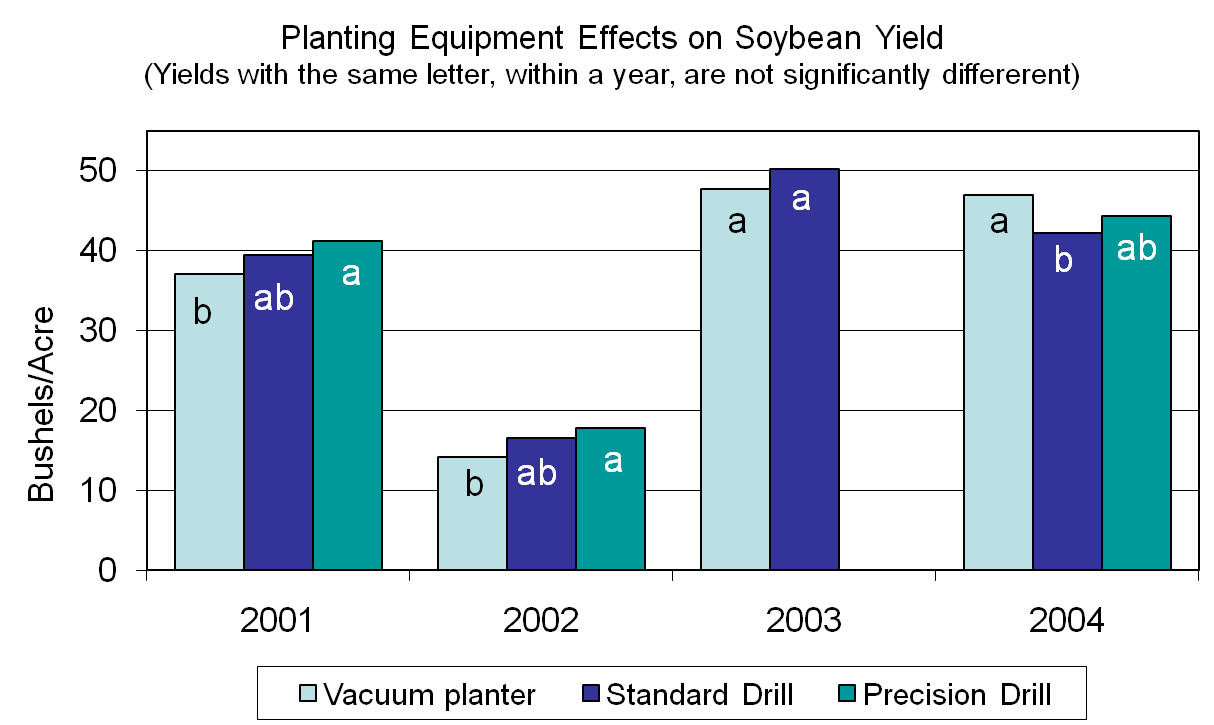
Stand uniformity with the precision drill was equal to the vacuum-meter planter and better than the standard drill. Yield results are also shown below.  Soybean yield with the standard drill was equal to the vacuum-meter planter in three of four years and less than the vacuum-meter planter in one year. Soybean yields were greater when planted with the precision drill than when planted with the vacuum-meter planter in 2 of 3 years, and averaged 10% over three years of study.

Share