Author Archives: David Holshouser

About David Holshouser

David serves as Associate Professor & Extension Agronomist at Virginia Tech’s Tidewater Agricultural Research and Extension Center. He provides leadership for agronomic extension and research programs that lead to profitable and environmentally-responsible agriculture.

Will Slugs Be A Problem in 2013?

Slugs are not a new problem, but they continue to be an unpredictable one.  It seems that they show up when and where we least expect them and never show up when and where we do.  But considering the cool and wet weather we’re experiencing, we should be on the watch.

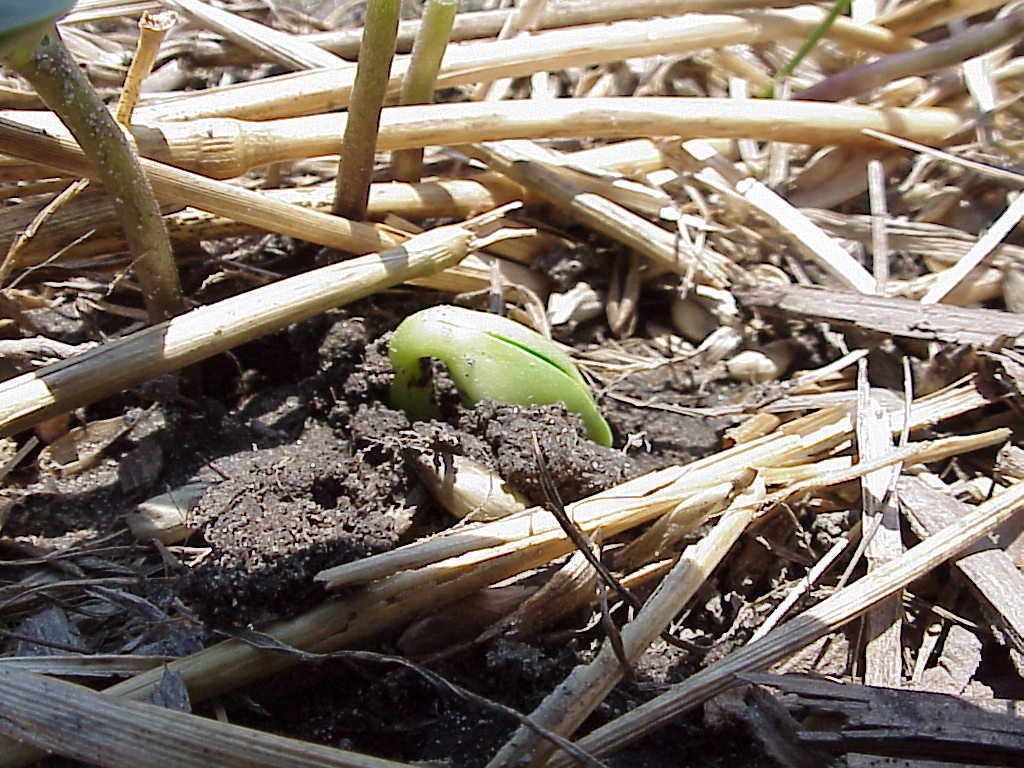
The photo below was taken last May, 5 days after planting in a no-till field with a rye cover crop.  Stand was about half of what was expected and feeding scars could be seen on the hypocotyl and cotyledons.  When digging in the seed furrow, slugs were more often present than not.

Slug Damage Soybean

Cold, wet weather slows seedling growth; therefore reducing the plant’s ability to outgrow slug damage.  Slugs will feed on all crops, taking large chunks out of the stem and sometimes cutting the plants like a cutworm.  They feed mostly at night although I’ve seen them feeding during cloudy days (see photo below).  In general, they are more of a problem in wet, poorly drained fields or in low-lying portions of fields.  Still, we’ve seen them on hilltops.  Slug on SoybeanThey are usually a problem in no-till fields with high residue crops such as corn or grain sorghum and/or in fields the slug underneath last year’s corn stalk.  If the seed furrow doesn’t fully close, slugs will follow this “highway” and eat seedling after seedling before it emerges from the soil.

Slug Under corn residueWhat can be done about this problem?  First, scout the field before you plant, paying close attention to poorly drained or low-lying portions of the field.  If you find slugs, you have a couple of options.  One is to not plant and wait for warmer and dryer weather.  Slug damage usually disappears under warm and dry conditions.

Another alternative is to apply the slug bait/molluscicide, Deadline®, which contains the active ingredient metaldehyde.  It is sold at Deadline® M-Ps™ Mini-Pellets (colored with a blue dye) and Deadline® Bullets (dye-free).  This is the only reliable treatment that we have available.  It must be spread evenly at 10 to 40 lbs per acre over the infested area.  The product is fairly expensive, so the 10 lb rate is the most common and has worked well in my experience.  The product is not commonly stocked by local retailers, so it can be hard to find.

Will slugs be a problem?  Maybe.  Maybe not.  But, with the current weather conditions, I’d suggest scouting those slug-prone fields.

Share
Posted in Fungicides, Pest Management | Tagged , , | 1 Comment

Full-Season Soybean Seeding Rates

My soybean seeding rate recommendation for full-season production systems is to plant enough seed to insure 80,000 uniformly spaced plants/acre.  If you cannot uniformly space the plants within a row, then my recommendation rises to 100,000 plants/acre.  Based on numerous seeding rate experiments conducted in Virginia, I feel very confident in this recommendation.

Of the 27 full-season seeding rate experiments conducted from 2004 to 2009, I can group soybean yield response to plant population into the following three categories: 1) no response to plant population; 2) optimum plant population of 75-100,000 plants/acre; and 3) optimum plant population of 100-140,000 plants/acre.  Below are individual tests that represent these categories.

Full-Season Seeding Rate Study - Virginia

First, note that these examples only show the response of yield to plant population and do not take into account seed costs.  When seed costs are included, the optimum plant population is lower than is shown on the graphs.  Also note that these graphs show yield response to plant population, not seeding rate.  To convert to seeding rate, adjust these numbers to reflect your expected percent emergence.  For example if you assume 75% emergence, you would need to adjust your seeding rate to 133,000 seed/acre to obtain 100,000 plants/acre.

We conducted these experiments with maturity group 4 and 5 varieties.  While one may think that more seed might be required for early-maturing varieties, this was not the case (i.e., group 4 and 5 varieties responded similarly).

There may be some correlation with yield potential as listed below:

  • 30-40 Bu/A Yield Potential (14 tests)
    • 6 required 100-130,000 plants/acre
    • 2 required 70-100,000 plants/acre
    • 6 had no yield response
  • 40-60 Bu/A Yield Potential (7 tests)
    • 2 required 70-100,000 plants/acre
    • 5 had no yield response
  • > 60 Bu/A Yield Potential (7 tests)
    • 2 required ~130,000 plants/acre
    • 4 required 70-100,000 plants/acre
    • 1 had no yield response

So, what do these data mean?  It means that every environment (year & location) is a little different and there is no way that we can predict with 100% accuracy the exact seeding rate that will be required for your field in the coming growing season.  However, we do know that if we can obtain full canopy closure (90-95% light interception) by full flower (R2 stage) to early pod (R3 stage), we can maximize soybean yield potential.  In a dry year or under a droughty soil (low yield potentials), greater seeding rates will help insure this.  Still in most cases (30 to 60 bushel yield potentials), 70-100,000 plants/acre are adequate.

What about fields with greater than 60 bushel yield potential?  In this case, we need to look beyond adequate leaf area and need to start thinking about how many pods the soybean plant can support.  For instance, at 40 bushels/acre and 100,000 plants/acre, we only need to produce 72 seed/plant (using 3000 seed/lb) or about 30 pods/plant (using 2.5 seed/pod).  But, at 60 bushels/acre, we need to produce 108 seed or 45 pods per plant; at 80 bushels/acre, we need 144 seed or 60 pods per plant.  Considering that 12 reproductive nodes per plant are possible, 4 to 5 pods per node on a rather tall plant would be required.  Although branching will also contribute to yield, that seems a lot to ask of one soybean plant.  So, if you are trying to win the yield contest or are irrigating soybean, I suggest planting enough seed to obtain 120-140,000 plants per acre in a full-season system; otherwise 80-100,000 plants are adequate.

Share
Posted in Planting | Tagged , , , | Leave a comment

Cool Soils Should Alter Your Planting Plans

It goes without saying that every year is different and this winter/spring has been wet and cold. I think that most of us have assumed that the soil temperatures are much below normal; therefore, holding off a few days with planting may be a good idea.  According to 2013 and five-year historical soil temperature records at Orange and Suffolk (from the USDA-NRCS Soil Climate Analysis Network weather stations), soil temperatures have been fluctuating quite a bit.Virginia Soil Temps 2013

After early-April soil temperatures proved to be much colder than normal, a week or two of warm weather put us back on track with average.  Then, temperatures dropped off again.  Fortunately, the last two weeks of cool weather have not lowered the soil temperatures all that much.

Although our soils have warmed substantially since early April, the temperatures are still less than optimum for soybean germination and emergence.  Ideally, I like to see temperatures hold steady at 65 to 70O or above.  The ideal temperature for soybean germination is 77O and the optimum range is 68 to 86O.  The maximum is 94O, where germination can be inhibited.  However, we can’t always wait for perfect temperatures if we are to get all of our soybeans planted on time.

Still, planting soybean in cool (<65O) will lead to delayed emergence and increased chance of seedling disease that can reduce stands, weaken emerged plants, and inhibit early-season growth.  For a more detailed description of fungal seedling disease in soybean, refer to an article I wrote last May on the subject and can be found in my Virginia Soybean Update blog.

I stress that the greater time required for emergence, the greater probability that the seed will become infected with soil-borne disease.  If you are planting into cool soils, I strongly suggest using fungicide-treated seed as an insurance against seedling disease. These treatments will protect the seed and seedling if emergence is delayed.

But, seed treatments should not be a substitute for other practices that encourage rapid seedling emergence.  Here is my checklist for insuring a good stand free of seedling disease:

  • Know the germination and vigor of your seed; adjust the seeding rate accordingly.
  • Insure good soil-to-seed contact by properly setting your planter to cut through the residue and penetrate to the proper depth.
  • Plant soybean seed ¾ to 1 inch deep into good soil moisture.
  • Consider fungicide seed treatments if planting into cool soils.
Share
Posted in Planting | Tagged , , , , | Leave a comment

It’s Time to Sample for Nematodes

Nematodes are unsegmented roundworms, some of which feed in or on roots of plants.  More than 100 species of plant-parasitic nematodes feed on soybean roots, but only a few are economically important.  In Virginia, most nematode species are found in the sandier Coastal Plain soils.  However, some nematode species can also develop and reproduce on the heavier-textured soils of the Piedmont and Shenandoah Valley.  This guide will focus on those that can cause damage to soybean in Virginia.

Many soybean growers do not realize that nematodes may be reducing yields by 7-8%.  Therefore management of these pests begins with sampling and determination of the species and number present.  If nematodes are determined to be a threat, certain management practices are available to help prevent further spread and reduce the economic losses that they cause.

During 2007-2010, over 1000 soil samples were taken and analyzed for nematodes in problematic corn and soybean fields in eastern Virginia.  These fields were not chosen at random, but were selected because of low productivity or were showing symptoms that were typical of nematode damage.  Of the “problem” soybean fields, 98% contained nematodes and 71% of the fields were at moderate to high risk of nematodes causing a significant yield loss.

Sampling and Thresholds.  Virginia Tech’s Nematode Advisory Program depends on the cooperation of the agricultural community, Extension Agents, and the Nematode Assay Laboratory. Proper sampling, completion of appropriate forms, and careful laboratory analysis are all necessary to provide the grower with appropriate recommendations on nematode management. The Nematode Advisory Program can help growers avoid costly yield loss due to plant-parasitic nematodes if the steps outlined below are followed.

The Virginia Tech Nematode Assay Laboratory currently performs assays for two different purposes:

  1. Predictive: The predictive assay determines if nematode populations at harvest are likely to affect next year’s crop.  There is a fee for predictive samples.  Routine assays are $11 per sample and routine plus cysts are $19 per sample.
  2. Diagnostic: The diagnostic assay determines if poor growth in the current year’s crop is caused by nematodes.  There is no fee for diagnostic samples.

When to Sample.  The most appropriate time to sample depends on the crop and the purpose of the sample.

Predictive Assays: Fall sampling provides the most reliable information for predicting nematode problems for a future crop. Nematode populations are highest at the end of the growing season and decline as the soil temperatures drop.  Sample at or immediately after harvest of previous crop, September 15 to November 15.

Diagnostic Assays: Sample at the onset of symptoms, during the growing season. Nematodes feed only on living plants; therefore, sample soil around live plants showing symptoms. Some nematodes spend part of their life cycle inside the roots and more accurate diagnosis of nematode damage can be made from samples including roots.  Also, send another sample from a healthy plant to compare population densities.

How to Sample.  Always sample within the feeder-root zone; this varies for each crop. Avoid collecting samples when the soil is extremely dry or extremely wet. DO NOT add water to the soil after sampling. Sample areas of common crop history. For example, if one half of the field is planted to corn and the other half to soybean, sample each area separately.

  1. Collect vertical core subsamples of soil with a soil sampling core or shovel within the feeder-root zone (see figure at right). A 6″ depth should be adequate. Nematodes do not occur uniformly throughout a field; thus, more than one subsample must be taken from the same field. The number of subsamples needed depends on the size of the field:
    1. For small fields (less than four acres), collect at least 20 subsamples.
    2. For large fields (more than four acres), divide the field into four-acre sections. If the field consists of several soil types, divide the field into as many sections as there are soil types. Collect at least 20 subsamples from each section.
  2. Mix the subsamples in a clean bucket.
  3. Place at least one pint (500 cc) of the soil mixture into a nematode soil sample bag or plastic bag. LABEL COMPLETELY with the grower’s name, address, county, agent, crop information, and field or sample number.
  4. Complete the appropriate form to send with the samples. The forms are available at Virginia Cooperative Extension offices at no charge.  Soil sample bags may be available at these offices, as well, however quart-size, sealable, plastic bags are also suitable.
  5. Store samples in a cooler or refrigerator until shipping.  It is best to ship samples on Monday or Tuesday to avoid them sitting in a hot mailroom or truck.
  6. Mail samples with the appropriate form, and a check for predictive assays, immediately to the Nematode Assay Laboratory, 115 Price Hall , Virginia Tech, Blacksburg, VA 24061-0331

Interpreting Predictive Assays.  Predictive nematode sampling use nematode risk thresholds to determine whether to take action against nematodes.  These thresholds are based on results of on-farm tests over several locations and years.  The table below lists three levels of risk for yield loss according to population densities in a 500 cc sample of soil.  Risk thresholds apply to soil samples collect in late summer or early fall.  Soil samples collected during winter or spring always contain reduced levels of nematodes due to unfavorable temperatures and the absence of a host crop.  Note that if more than one nematode is present at the borderline level, the likelihood of a profitable response to a control measure increases.

Nematode Risk Thresholds for Soybean (per 500 cm3 soil)

Risk Level

Nematode

Low

Moderate

High

Soybean Cyst larvae

0-20

20-60

>60

cysts

0

-

>1

Lance

0-300

300-1000

>1000

Lesion

0-100

100-500

>500

Ring

0-200

200-700

>700

Root Knot

0-50

50-170

>170

Spiral

0-1000

>1000

-

Sting

0-10

10-20

>20

Stubby Root

0-90

>90

-

Stunt

0-300

300-1000

>1000

Recommendation Codes:Low = nematodes are no likely to cause crop damageModerate = borderline populations in which crop damage may occur if other factors stress the cropHigh = populations are likely to cause crop damage and significant yield loss

For more information on soybean nematodes and their management, see the VCE publication AREC-9, Soybean Nematode Management Guide.  You can access the guide on the web at http://pubs.ext.vt.edu/ or obtain a hard copy at your County Extension office.


Share
Posted in Nematodes | Tagged , | Leave a comment

Now is a Good Time to Evaluate Your Varieties for Foliar Diseases

September is a great time to evaluate your crop and the performance of varieties that you chose.  In addition to general growth and health of the crop, take some time to determine if you have any of the below diseases.  If so, you could be losing some yield.  If you sprayed with a fungicide and still have disease, reconsider the product and rate used and the time that the fungicide was applied.  Keep in mind the weather conditions when the application was made and the conditions 2 to 3 weeks after or before the product was applied.  Cool temperatures (70’s) and high relative humidity (>95% for 12 hours or more) will usually increase disease incidence.

Another caution is to never diagnose a specific disease on the plant without verifying it with a person trained to identify plant pathogens.  Only when the reproductive structures are found on the leaf can a disease be confirmed.  Many things will cause look-alike symptoms.  Be sure before you cast the blame.  There are more diseases than just the ones shown below, but these are the most common.  Brown spot is normally found in the lower part of the crop canopy (the lower leaves), Cercospora blight and leaf spot will be found throughout the canopy, and the frogeye leaf spot and downy mildew tend to be found in the upper part of the canopy.


Share
Posted in Disease, Variety Selection | Tagged , , , , , | Leave a comment

Corn earworm AVT results, BMSB and Kudzu bug update….nearing the end (Dr. Ames Herbert)

Our final batch of corn earworm moths showed only 26% survivorship, down from last week. This season results showed a 37% survival rate for the seasonal total which exceeds all previous years. We are now up to 33 counties where brown marmorated stink bugs were/are present in soybean fields. Most are at pretty low levels compared with last year, but they are much more widespread. This week n some have been found in soybean fields in north central North Carolina. We are taking as much data as we can to help with answers for next season. And, the first kudzu bug nymphs were found in Charlotte County. We are nearing the end of this season in terms of insect pests and advisories…a long summer for sure.

Share
Posted in Insect Pests | Tagged , , | Leave a comment

Brown Marmorated Stink Bugs Infesting Soybean Fields – Not Playing By the Rules (Ames Herbert, Extension Entomologist)

With our full complement of field scouts in place, more soybean fields are being found with brown marmorated stink bug (BMSB) infestations. We are up to 20 counties in Virginia spread over a very large area of the state. Infestations were a little slow to develop compared with last year but we are predicting that by the end of the season, many more fields will be infested compared with last year. So far, most infestations are at low to moderate levels (from 2-3 to 4-6 per 15 sweeps) but a few are in the high infestation range 8-10 or more/15 sweeps. We know that sweep netting is not the ideal way to sample for these insects, but there is no other method other than simply easing into the field edge and counting what you see. Basically, if you can stand in one spot, do a 360 degree turn and count more than 5 or 6, that area needs protection. So, how are they not playing by the rules?  Last season, our first with treatable levels, bugs stayed on field edges and a single insecticide edge treatment provided season long control. This is true for many fields this year but in a few we are finding them deeper into fields, and, there are some cases where re-infestations are occurring in fields previously treated. The good news is that 1) based on our insecticide trials it is not difficult to kill them with several common products, and 2) many fields, especially the full season crop fields, are rapidly approaching the safe stage which based on previous field cage studies happens after R6 (full seed) when pod walls begin to toughen. Many growers are treating field edges this year and we are going to follow as many as possible to determine if those treatments worked and held. More on this as we progress.

This report was taken directed from Dr. Herbert’s Weekly Virginia AG Pest Advisory.  To access this advisory, go to http://www.sripmc.org/Virginia.


Share
Posted in Insect Pests | Tagged , | Leave a comment

Soybean Crop is Still at Risk to Drought & Pests

Our soybean crop is moving right along.  Much of our May-planted crop has hit or it approaching the R6 stage.  Our double-cropped soybeans are in the R4-R5 stage depending on their maturity, planting date, and whether or not they experienced early-season drought.  There’s a tendency for us to believe that the crop is made after the seed have met in the pod.  However, as shown below, only 50% of our yield has been made at the R6 stage. 

Dry weight will continue to accumulate in the seed for the next 3 weeks until the crop reaches the R7 stage (physiological maturity), which is defined as one pod on the plant that has reached its final mature color.  Much of this seed weight is due to translocation from other plant parts, especially the leaves and petioles (remobilization).  Sometimes soybean is called a self-destructing plant.  This is largely true.  As photosynthate is moved from the leaves to the seed, the leaves will turn yellow and drop from the plant.  If the leaves are yellowing and dropping due to this natural process, then we shouldn’t be concerned.  However, if the leaves are dropping due to another reason such as dry weather or disease, we should take notice.  It is important to keep the leaves green as long as possible to maximize yield.

It takes about 2 weeks to move from the R5 to R6 stage and another 3 weeks for to move from R6 to R7.  This is a long time and much can happen during this period.  First, we must protect the developing seed from insects such as corn earworm and stink bugs.  After R6, these two pests are not as much of a concern, but defoliators such as soybean looper can still remove green leaf area, which I’ve already stressed, is vital for maximum yield.  We also need to be concerned about foliar disease, which can also rob us of green leaf area

Share
Posted in Pest Management, Yield | Tagged , , , , , | Leave a comment

Foliar Fungicides for Soybeans

Ten years ago, few farmers considered applying foliar fungicides for soybeans.  These crop protection products had their home with higher-value crops such as vegetables and peanuts, where a return on investment was more likely.  But with soybean futures topping $16, more growers are using fungicides to protect their soybeans from common diseases and hopefully to increase yields.

The question that is still plaguing nearly everyone is will the fungicides pay for themselves this year?  The answer is really quite simple – We Don’t Know!  Why don’t we know?  First, the fungicides that effectively control our most common soybean diseases, the strobilurin fungicides (e.g., Headline, Quadris, etc.) are preventative.  In other words, they must be applied before the disease develops.  So, we’re applying a chemical to prevent a disease that may or may not progress to yield-reducing levels.  Unfortunately, our ability to predict soybean disease development is not very good.  Therefore, we rely on results from applied research, experience, and the probability of getting a response.

How likely are we to get a response to fungicides in Virginia?  We regularly test fungicides on soybean and have built up a fairly large database.  While disease incidence is reduced with fungicide application, a significant yield response occurs only about 1/3 of the time.  The average yield response is 3 to 4 bushels per acre, regardless of whether we average over only experiments with significant responses or over all experiments.  We’ve seen yield increases up to 12-14 bushels, but that type of response is rare.  So, if you can average 3 to 4 bushels per acre over all acres, then a fungicide will likely pay for itself – unless we experience one of those years where disease is nearly absent (remember how dry it was last year?).  If there’s no disease, we’ve wasted our money.

Although we do not yet have an effective weather model (such as is being used in peanut) that will guarantee success, we can make an informed, although not perfect, decision.  We must remember that three conditions must be present in order for a disease to develop: 1) a susceptible host; 2) the pathogen; and 3) a conducive environment.  This concept is commonly referred to as the plant disease triangle.  If any of these three is missing, then the disease will not develop.  We have the host – soybean.  And we usually have some yield-robbing pathogens present – especially the Cercospora species.  But the variety used must be susceptible to the pathogen.  This includes two things: genetics and stage of soybean development.  From the genetic standpoint, we have many varieties with resistance to frogeye leaf spot (Cercospora sojina), probably the most damaging disease that is annually present in Virginia.  So, if you’re using a frogeye leaf spot resistant variety, response to fungicides is less likely.  Certain varieties are more susceptible to cercospora blight (Cercospora kikuchii); some are less susceptible.  But few have true resistance.  Cercospora blight is likely most responsible for yield loss to to foliar disease and the reason that fungicides prevent soybean yield losses in Virginia.  Regarding stage of development, soybean disease usually appears after full flower (R2) and the soybean are just beginning to pod (R3).  This can be attributed to a larger canopy at this stage (which is related to the environment side of the triangle – see below discussion), but may also be related to physiological changes taking place in soybeans as plants transition from vegetative to reproductive growth.  So if the pathogen is present on a susceptible host, there is a greater likelihood that a disease will develop.  Still, the environment has to be right.

What is the right environment?  Temperatures ranging from 60 to 85 F in periods with moisture provided by rainfall, dew, or high relative humidity is usually required.  The greater number of days that these conditions are met, the more disease there will be. The weather service is pretty good at predicting temperatures, but not so great with rainfall.  Additionally, even if rainfall is predictable, the environment within the soybean canopy (micro-environment) is usually what matters most.  A tall soybean crop that has completely closed its canopy and is growing in good soil moisture will result in a micro-environment more conducive to disease development than a short crop that has not closed the canopy and is growing in a relatively dry soil.

In summary, all three conditions shown on the disease triangle must be present for a disease to develop to yield-robbing levels.  We do not yet have a good model to predict common soybean diseases – but we are working on it.  Until such a model is developed, Dr. Pat Phipps and I suggest the following guidelines on whether or not to spray a foliar fungicide on soybeans:

  • Soybeans are growing well, have a full canopy, and are in the R3 (beginning pod) to R5 (beginning seed) stage.  Research indicates that applying fungicides at R3 is better than later stages.  Note that most fungicides cannot be legally applied after they have reached the R6 (full-seed) stage.
  • Daily air temperatures averaging between 60 and 77 F and accumulations of rainfall were ≥ 0.5 inches in the previous 5 days or ≥ 1.0 inches in the previous 10 days, or periods of relative humidity were ≥ 95% for ≥ 12 hours per day.  The greater number of days that these conditions are met, the greater likelihood for a response to fungicide application.

When soybeans were $5 to 6 per acre, very little foliar fungicide was being applied to soybean.  However with today’s prices, yield is king; therefore, a small yield increases resulting from an external input such as foliar fungicides can be cost effective.

Share
Posted in Disease, Fungicides | Tagged , , | Leave a comment

Corn earworm moths already showing high levels of pyrethroid resistance in Virginia

From Ames Herbert via the Virginia Pest Advisory (http://www.sripmc.org/Virginia/)


As of the end of this week (June 29, 2012) we have tested 372 corn earworm (CEW) moths for pyrethroid susceptibility and have a season average of 31.2% surviving the AVT (adult vial test) challenge (see the attached line graph). We had one sample with over 40% survivorship. These are high numbers for the beginning of the season and compare pretty well to what we had at this time in 2011, if not a bit higher. What does this tell us? We cannot claim pyrethroid resistance based on this kind of random survey of moths, but historically, when we see survival numbers of about 25-30% or higher, we can expect some pyrethroid control problems, especially if moth fights are heavy, and the weather turns dry. That combination would almost guarantee control problems. But, if CEW populations reach only low to moderate numbers and the season continues to get plenty of rainfall, field failures will not be nearly as common. With loss of Larvin, an effective non-pyrethroid for controlling CEW, growers will need to turn to other non-pyrethroids like Belt, Coragen (Prevathon**), Steward, or combinations that include a pyrethroid plus a non-pyrethroid either tank mixed (like a pyrethroid + Orthene) or as a product (like Besiege** which contains Karate and Coragen). (**note, the registration status of these products is not certain at this point)

Share
Posted in Insect Pests | Tagged , | 1 Comment